
Table of Contents
Summary
A small plastic part usually costs ₹200 to ₹2,000 from an Indian 3D printing service, based on FDM rates of ₹5 to ₹20 per gram. Resin and nylon parts cost more, and metal parts start in the thousands.
Every price has five parts: material, machine time, setup, finishing and 18% GST. Machine time often costs much as material with hourly rates from rupees 15 to rupees 30 for desktop FDM and up to rupees 200 for industrial machines. Setup adds file repair and design work and finishing adds rupees 100 to rupees 400 for light sanding.
Quotes differ because shops bill per gram per cm³ or, per hour use machines and print settings set different minimum orders, charge different shipping and either include GST or add it later. Always ask whether GST is included.
Our worked examples above show the same 100 g part costing about ₹425 to print at home and ₹1,298 from a service with GST.
To compare quotes fairly, send every vendor the same file and the same specifications. Voxelcore reviews each file with an engineer, returns most itemised quotes within four working hours, and also issues a GST compliant invoice.
Key takeaways
- Material is only one part of the price. Machine time, setup and finishing often cost as much.
- Rates vary a lot because shops bill in different ways: per gram, per cm³ or per hour.
- Many bureaus add 18% GST to the service invoice. Always ask whether a quote includes it.
- Minimum order charges, shipping and file repair can push a small job well above the headline price.
- Printing the same part yourself can cost a third of a service quote, but only after you own and understand a printer.Introduction
Last reviewed: 16 October 2026. All rates in this guide are 2026 market rates.
Two shops quote you for the same 3D printed part. One says ₹600. The other says ₹1,900. Nobody explains the gap, and you still have to pick one.
This guide explains the gap. You will see where every rupee goes, what GST adds, which fees hide in the fine print, and how to compare quotes so you pay a fair price.
How Much Does 3D Printing Cost in India?
A small plastic part usually costs ₹200 to ₹2,000 from an Indian 3D printing service. That range comes from typical FDM printing rates of ₹5 to ₹20 per gram. Resin and nylon parts cost more, metal parts start in the thousands, and 18% GST applies on top unless the quote already includes it.
What Makes Up a 3D Printing Price?
Every quote you receive is built from five parts:
- Material: the plastic, resin or powder in your part, plus supports and waste.
- Machine time: how long the printer runs, billed at an hourly rate.
- Setup: file checks, repair, orientation and slicing.
- Finishing: support removal, sanding, painting and similar work.
- GST: 18% on most invoices.
One Indian bureau, IAMRapid, estimates that machine time makes up 30 to 50% of the price, material 20 to 40%, and finishing plus labour 15 to 30%. So a quote built on material weight alone misses most of the picture.
How Much Does the Material Cost?

Material is the part everyone checks first, and it is rarely the biggest line.
FDM Filament Prices in India
A 1 kg spool of PLA costs around ₹800 to ₹3,000. This depends on the brand, colour and where you buy it. Engineering plastics like nylon and carbon fibre blends are more expensive—about ₹4,000 to ₹6,000 per kg. Some sources say the lower end is cheaper but not all agree. So if you see one price don’t take it as the full truth. Check than one place, before buying.
Resin and Nylon Powder Prices
SLA resin costs about ₹3,000 to ₹8,000 per litre. Castable and high temperature resins cost more. SLS and MJF nylon powders run about ₹5,000 to ₹12,000 per kg.
Supports, Waste and Failed Prints
Overhangs need support structures, which add roughly 15 to 20% extra material. Failed prints add another 5 to 10% of print time. Someone pays for that, and it is usually you.
Why Does Machine Time Cost So Much?
A printer that runs for eight hours is not available for another customer. So shops charge for the hours, not just the grams.
Hourly Machine Rates by Printer Type
Published rates, such as those on IAMRapid’s pricing page, vary with the machine:
| Machine type | Typical hourly rate |
| Desktop FDM | ₹15 to ₹30 |
| SLA resin | ₹40 to ₹80 |
| Industrial SLS and MJF | ₹80 to ₹200 |
Some bureaus charge far more for FDM. One lists PLA at ₹110 an hour and ABS at ₹130. Another listing shows ₹250 an hour. That spread alone can explain a big part of the quote gap.
Printer Wear and Electricity
A shop also has to recover the cost of the printer. A ₹25,000 machine that lasts 5,000 print hours costs about ₹5 for every hour it runs, before repairs, according to Zbotic’s cost guide.
Electricity is the smallest line. A desktop printer draws about 200 watts, which costs roughly ₹1.60 an hour at ₹8 per kWh, based on Zbotic’s pricing formula.
What Does Setup Add to the Price?
Setup is the work before the printer starts. A technician checks your file, repairs broken geometry, picks an orientation and prepares the print job. If you do not have a 3D model, design work costs about ₹500 to ₹3,000 per design hour, according to an Indian pricing benchmark. If you already own the physical part, 3D scanning can capture it and save design hours.
Many shops also set a minimum order. One bureau listed in All3DP’s India roundup asks ₹1,000 for SLA and SLS jobs, and another asks ₹150. A ₹90 part can therefore turn into a ₹1,000 invoice.
How Much Does Finishing Cost?
A raw print shows layer lines and support marks. Finishing hides them. The common steps are:
- Support removal
- Sanding
- Primer and paint
- Vapor smoothing, for ABS parts
- Adding threaded inserts
Most of this is labour time. In a typical example, light support removal and sanding adds about ₹100 to ₹400. A painted, showroom quality part can add much more. If you only need a test fit, skip finishing and save that money.
How Does GST Work on 3D Printing in India?
GST is where many buyers get confused, so here is the plain version.
GST on Printers and Filament
3D printers (HSN 8477) are taxed at 18%, and that rate did not change after the September 2025 revision, according to Busy’s GST guide for printers. Plastic filament (HSN 3916) is also taxed at 18%.
GST on Printing Services
Most bureaus add 18% GST to the service invoice. Classification can vary with the job. Busy’s guide to printing services shows that general printing falls under SAC 9989 at 18%, while job work on material you supply can sit under SAC 9988 at 5% or 18%. If you need input tax credit for your business, ask the vendor for the correct SAC code on the invoice and confirm it with your accountant.
Is the Quote GST Included or Excluded?
This is the trap. A quote of ₹1,100 plus GST is ₹1,298. A quote of ₹1,250 with GST included is cheaper, even though the first number looks lower. Some very small sellers are not registered for GST at all. Their price may look lower, but you cannot claim input tax credit on it.
What Does a Real 3D Printing Price Look Like?
These examples use the market rates above. They show how the parts add up. They are not quotes from any specific company.
Example 1: Printing a 100 g Part at Home
This part prints for 8 hours with supports included.
| Line | Cost |
| Material (115 g with supports, plus a failure allowance) | ₹152 |
| Electricity | ₹13 |
| Printer wear | ₹60 |
| Your time (40 minutes) | ₹200 |
| Total | ₹425 |
Example 2: FDM Part from a Service
A service prints the same part in FDM.
| Line | Cost |
| Material (115 g at ₹6 per gram) | ₹690 |
| Machine time (8 hours at ₹20) | ₹160 |
| Setup and file prep | ₹150 |
| Finishing | ₹100 |
| Subtotal | ₹1,100 |
| GST at 18% | ₹198 |
| Total | ₹1,298 |
That works out to about ₹13 per gram of finished part.
Example 3: SLA Resin Part from a Service
A service prints a 50 cm³ part in SLA resin.
| Line | Cost |
| Material (50 cm³ at ₹35, plus 20% supports) | ₹2,100 |
| Machine time (4 hours at ₹60) | ₹240 |
| Finishing and curing | ₹400 |
| Subtotal | ₹2,740 |
| GST at 18% | ₹493 |
| Total | ₹3,233 |
Why Do Two Quotes for One Part Look So Different?
Here are the real reasons, in the order they usually matter.
- Different billing methods. One shop charges per gram, another per cm³, another per hour. The same part lands at a different price under each.
- Different print settings. Some online quote tools price a part at about 20% infill with thin walls. A strong part needs more material. One pricing guide says full infill adds roughly 35%.
- Different machines. A ₹30,000 desktop printer and an industrial SLS machine that costs lakhs do not share a price list.
- Part shape. A tall, spread out part takes up build space even when it weighs little, and some shops price that in. Fabbaloo explains how pricing formulas can treat the same geometry very differently.
- Minimums and shipping. One bureau lists shipping at ₹150 to ₹500 in South India and ₹550 to ₹1,000 in North India.
- GST included or not. Covered above, and it changes the total by 18%.
- Finishing and design. One shop includes sanding, another charges extra.
- Seller type. A hobbyist, a bureau and a trading company all run on different costs.
How Do You Compare 3D Printing Quotes?
Most people compare the final number. Compare the inputs instead.
- Send every vendor the same file. Use STL, or STEP if you want dimensional accuracy.
- State the material, infill percentage, wall thickness, quantity and finish in writing.
- Ask whether GST is included, and request the SAC code.
- Ask about minimum order charges and shipping to your pin code.
- Ask if file repair, supports and finishing are included.
- Ask for the turnaround time, including dispatch.
Put the answers side by side. The cheapest total is often not the cheapest honest quote.
Which Hidden Fees Should You Watch For?
Check each quote for:
- Minimum order charges
- Shipping by region
- File repair or CAD fixes
- Rush or priority fees
- Revision rounds
- Packaging charges
- GST, if the quote leaves it out
3D Printing Cost by Technology
| Technology | Typical rate | Best for |
| FDM | About ₹5 to ₹20 per gram | Strong, low cost prototypes and large parts |
| SLA resin | About ₹30 to ₹40 per cm³ for standard resin | Smooth surfaces and fine detail |
| SLS and MJF nylon | About ₹32 to ₹40 per cm³ | Durable, end use parts |
| Metal | Starts in the thousands | Strong, heat resistant parts |
Units differ across shops, so convert before you compare. Specialty resins can run above ₹100 per cm³, and complex metal parts can pass ₹50,000. When you need tight tolerances in metal or engineering plastics, CNC machining can be the better route than printing.
Should You Buy a Printer or Use a Service?
Say a service quotes ₹1,298 for the part in Example 2. Printing it yourself costs about ₹365 in material, electricity and your time. You save roughly ₹930 per part. A ₹25,000 printer then pays for itself after about 27 parts of that size.
That math only works if the parts suit a desktop machine and you have time to learn it. A home printer will not match industrial SLS accuracy, and it cannot print metal. If you need a handful of parts, a professional 3D printing service is usually cheaper once you count the learning curve.
Is 3D Printing Cheaper Than Injection Moulding?
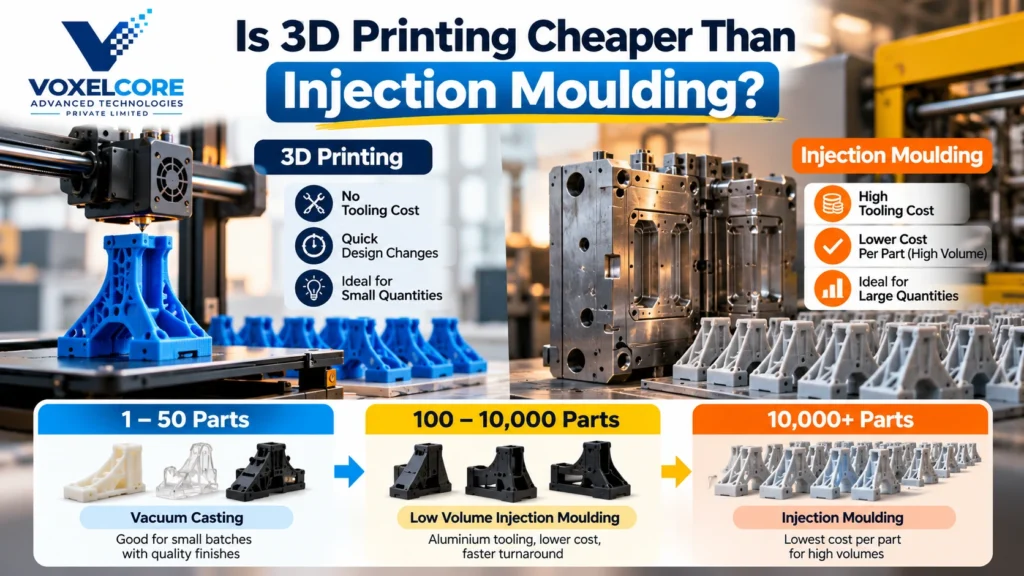
For small quantities, yes. Injection moulding needs a steel or aluminium mould, which is a large upfront cost. 3D printing needs no tooling, so a design change costs one part, not a new mould.
As quantities climb into the thousands, moulding wins on cost per part. In between, you have options:
- Small batches of 1 to 50 parts: vacuum casting gives you polyurethane parts with cosmetic finishes.
- Runs of about 100 to 10,000 parts: low volume injection moulding uses aluminium tooling, which costs less and arrives faster than steel.
- Mixed needs: low volume manufacturing combines printing, machining, casting and bridge tooling so you can start producing without committing to full tooling.
The honest answer depends on your quantity, so ask a shop that offers more than one process.
How Can You Lower Your 3D Printing Bill?
- Hollow it out. Lower infill and thinner walls cut material and time.
- Rotate the part. Better orientation reduces supports.
- Batch your parts. Printing several together lowers the cost of each.
- Skip the finish on test parts. Sand and paint only the final version.
- Pick the right material. PLA is fine for a fit check. Pay for nylon or resin only when the job needs it.
- Send a clean file. Repair costs disappear when the model is already sound.
- Ask for a design review. A small change often removes a large cost.
What Will 3D Printing Cost in 2027?
Nobody can promise a number, and every rate in this guide comes from 2026. What you can do is watch the three things that move prices: filament and resin costs, GST rules, and how many Indian shops add industrial machines. Check the review date at the top of this page for the latest update.
How Does Voxelcore Quote Your Part?
Voxelcore is an Indian additive and precision manufacturing company. You can read the full story on the About Voxelcore page or in this simple guide to how Voxelcore works. Its 3D printing service covers FDM, SLA, SLS, MJF and metal, and the team also offers rapid prototyping, CNC machining, vacuum casting, low volume injection moulding and 3D scanning.
Here is how a quote works:
- You send a file or a description. STEP, STL, OBJ and 3MF files all work. A sketch or photo is fine if you do not have a model.
- An engineer reviews it personally. Nobody sends you an automatic number that ignores your design.
- You get an itemised quote. It reflects the material, process, quantity and finish. Small functional prototypes start from a few hundred rupees.
- Most quotes come back within four working hours. You also get design for manufacture feedback.
- Your invoice is GST compliant, and an NDA is available if your design is confidential.
- Your parts ship across India.
Ready to see your own numbers? Request a quote, message the team on WhatsApp, call +91 89302 11508 (Monday to Saturday, 9am to 6pm IST), or write to contact@voxelcore.in.
Frequently Asked Questions About 3D Printing Cost
How Much Does 3D Printing Cost per Gram in India?
FDM printing usually costs about ₹5 to ₹20 per gram at a service. Resin and nylon cost more. Added labour, setup and GST raise the final price.
How Much Does One Hour of 3D Printing Cost?
Desktop FDM machine time is often ₹15 to ₹30 per hour, SLA about ₹40 to ₹80, and industrial machines ₹80 to ₹200. Some bureaus charge more.
Is GST Charged on 3D Printing in India?
Most bureaus charge 18% GST on the service. Printers and filament are also taxed at 18%. Ask for the SAC code if you need input tax credit.
Why Do Vendors Quote Different Prices for One File?
They bill per gram, per cm³ or per hour, use different machines and settings, and handle minimums, shipping and GST differently.
What Is the Minimum Order for 3D Printing?
It varies. Some shops ask ₹150, others ₹1,000 for resin or nylon jobs. Some state no minimum, so ask before you upload.
Is Resin Printing More Expensive Than FDM?
Usually yes, per cm³. Resin gives smoother, more detailed parts, which is why designers pay the extra.
How Much Does Shipping Add?
One bureau lists ₹150 to ₹500 in South India and ₹550 to ₹1,000 in North India. Check shipping to your pin code.
Is It Cheaper to Buy a Printer or Use a Service?
For a handful of parts, a service is usually cheaper. If you print dozens of similar parts, a desktop printer can pay for itself.
How Much Does Finishing Add to the Cost?
Light support removal and sanding often adds ₹100 to ₹400. Painting and smoothing cost more.
How Do I Get an Accurate Quote?
Send a clean STL or STEP file. State the material, infill, quantity and finish. Ask whether GST and shipping are included. You can send your file to Voxelcore and get an itemised quote from an engineer.
The Bottom Line: Get a Fair 3D Printing Price
3D printing prices look random until you see the pieces: material, machine time, setup, finishing and GST. Know those five parts, ask every vendor the same questions, and you will spot a fair quote fast. When you are ready, send your file to Voxelcore and get an itemised number from an engineer who reads your design.
Sources and Method
Prices come from Indian service listings and published rate guides reviewed in October 2026, and the worked examples are illustrations, not quotes. GST information comes from Busy’s GST rate pages and printing services guide. Hourly rates, material ranges and per cm³ prices come from IAMRapid’s pricing page. Per gram, depreciation and electricity figures come from Zbotic’s cost guide and pricing formula. Design rates come from Zbotic’s business guide. Minimum order and shipping figures come from All3DP’s India roundup. Background on pricing formulas comes from Fabbaloo.