
Table of Contents
Summary
Choosing between 3D printing, CNC machining and injection moulding comes down to one question: how many identical parts do you need, and is your design final? 3D printing has no tooling cost, so it suits one to about fifty parts and designs that may still change. CNC machining cuts parts from solid blocks, which gives tight tolerances, strong parts and metal options. It suits small to medium runs where accuracy matters. Vacuum casting fills the gap many guides skip.
It makes ten to a few hundred plastic parts with a clean finish, using a silicone mould. Soft tooling, which means an aluminium mould, suits roughly one hundred to one thousand parts. Injection moulding needs the biggest upfront spend, but each part then costs very little, so it wins at many hundreds or thousands of identical parts. To find your own line, divide the mould cost by the saving per part. A ₹1,00,000 mould with a ₹130 saving breaks even near 770 parts. Sources disagree on exact thresholds, so treat every number as a starting point and ask for a written quote. Metal, tolerance, finish and design stability can all move the answer.
Key takeaways
- 3D printing suits 1 to about 50 parts and designs that may still change.
- CNC machining suits metal, tight tolerance and strong parts in small to medium runs.
- Vacuum casting suits roughly 10 to 300 plastic parts with a good finish.
- Soft tooling suits roughly 100 to 1,000 parts and costs about 20 to 40 percent of a production mould.
- Injection moulding suits many hundreds or thousands of identical parts with a final design.
- Break even quantity equals mould cost divided by the saving per part.
- A doubled mould price doubles the break even quantity, so get a real quote first.
- Do not cut a mould before the design is final.
- Plan for each stage: a few parts now, a pilot batch next, volume later.
- Most manufacturing services carry 18 percent GST, but confirm the service code with your accountant.
The short answer
Choose 3D printing for 1 to about 50 parts, especially when the design may still change. Choose CNC machining when you need tight tolerances, metal, or strong parts in small to medium runs. Choose vacuum casting for roughly 10 to 300 plastic parts that need a clean finish. Choose injection moulding when you need many hundreds or thousands of identical parts, and your design is final.
Those numbers are starting points, not rules. Part size, material, finish and design stability can move the line. The rest of this guide shows you how to find your own line.
The Quick Quantity Guide
Use this table first, then read the reasons below it.
- 1 to 10 parts: 3D printing. CNC machining if you need metal or very tight tolerance.
- 10 to 50 parts: 3D printing for complex shapes. CNC machining for strength and accuracy.
- 50 to 300 parts: Vacuum casting for plastic parts with a good finish. CNC machining if the part is simple and needs precision.
- 100 to 1,000 parts: Soft tooling, which means an aluminium mould. It costs less than a full production mould.
- 500 to 1,000 or more identical parts: Injection moulding.
These bands come from the global guides by Hubs and Fictiv, plus an Indian volume guide from Zbotic. The three sources do not agree exactly, and we will explain why in a moment.
Why Quantity Changes the Best Process
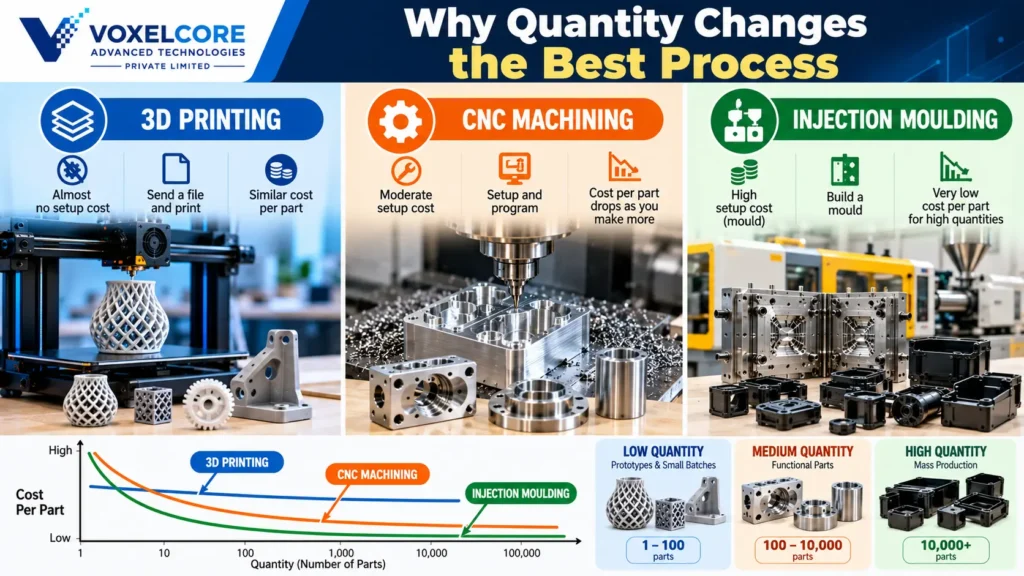
Every process has a different mix of setup cost and cost per part.
3D printing has almost no setup cost. You send a file, and the machine prints. But every part costs about the same, whether you make one or one hundred. The price per part drops only a little as you order more.
CNC machining doesn’t cost much to get started. You need someone to set up the machine and program it. Also you have to hold the part in the place while it’s being made. Once that’s done, making each part is fast and easy. The more parts you make the cheaper each one gets.. Even then the cost per part never gets as low as with injection moulding.
Injection moulding is expensive to start. You have to build a mould. That mould is usually made from steel or aluminium. That upfront cost is high.. After the mould is ready each part is very cheap to make. So when you need a lot of parts moulding is the choice. If you only need a few it’s not worth it. That’s why moulding works best for production runs and not so much, for small ones.
So the real question is simple. At what quantity does a bigger upfront cost pay for itself? That is a break even question, and we will do the maths below.
3D Printing: Best for Speed and Changing Designs
3D printing builds a part layer by layer from a digital file. You need no tooling, so you can print version one on Monday, change the design, and print version two on Tuesday.
It works well for:
- Prototypes and test fits
- Small batches and pilot runs
- Complex shapes, such as internal channels, lattices and curved forms that other methods cannot make
- Parts you may redesign soon
Accuracy depends on the type of printer. Hubs lists industrial FDM at about ±0.2 mm and SLS at about ±0.3 mm. A desktop printer is looser than that.
If you want a full look at what drives the price of a print, read our guide to 3D printing cost in India. To see how quotes work, read how to get a 3D printing quote in India.
CNC Machining: Best for Tight Tolerance and Strong Parts
CNC machining cuts a part from a solid block of metal or plastic. A computer controls the cutter, so the shape is exact and repeatable.
It works well for:
- Metal parts, such as aluminium, stainless steel and brass
- Tight tolerances, which Hubs puts at ±0.025 to ±0.125 mm
- Strong, solid parts, because a machined part has the same strength in every direction, unlike many printed parts
- Small to medium runs that need steady quality
CNC has limits too. The cutter must reach every surface, so some inside shapes are hard or impossible to make. Setup also takes real skill and time.
On the price side, one job work seller on IndiaMART lists CNC and VMC work at ₹250 to ₹450 per hour. That is one seller’s listing, so treat it as a rough signal and not an industry rate. Rates change by city, machine type and material. Read more about this process on our CNC machining page.
Vacuum Casting: The Middle Option People Skip
Most comparison articles jump straight from printing to moulding. That leaves a gap, and it is the gap where many Indian startups sit.
Vacuum casting makes a silicone mould from a master part, then pours liquid plastic into it. Fictiv says urethane casting suits about 1 to 300 parts. Wevolver says the master and mould take about 3 to 7 days, and a production run takes about 1 to 2 weeks.
It works well for:
- Plastic parts that need a smooth, product like finish
- Runs of tens or a few hundred
- Teams that need parts before they can afford a steel mould
It has limits. Silicone moulds wear out after a modest number of parts, and the plastic is a close match for production material, not an exact one. Wevolver gives a typical accuracy of about 0.3 percent of the part size.
Learn more on our vacuum casting page.
Injection Moulding: Best for High Volume
Injection moulding pushes melted plastic into a metal mould. Each cycle takes seconds, so thousands of parts come out fast, and each one costs very little.
It works well for:
- Large runs of identical parts
- A final design that will not change
- A wide choice of production plastics
- Tight repeatability across thousands of parts
Wevolver notes typical mould cavity accuracy of about ±0.1 mm, and as tight as ±0.025 mm in some cases.
The catch is the mould. Zbotic quotes a simple mould in India at ₹50,000 to ₹2,00,000, and says moulded parts can cost ₹5 to ₹50 each. It also mentions ₹5 to ₹20 lakh when a startup plans for market validation. That is a very wide range, and the sources do not explain it. The size and complexity of the part, the number of cavities, and the steel or aluminium choice all play a part. Always ask for a written quote before you decide.
For the production route, see our pages on injection moulding and low volume injection moulding.
Soft Tooling: The Bridge Between Casting and Full Production
If you need a hundred parts but not many thousands you can use an aluminium mould. Fictiv says this tooling costs about twenty to forty percent of a full production tool. It makes parts out of production plastic so the parts behave like the final product.
The trade offs are shorter mould life and a longer wait than casting. It suits the 100 to 1,000 part range best.
A Simple Break Even Example
Here is how to check the numbers yourself. The formula is:
Break even quantity = mould cost ÷ (printed part cost − moulded part cost)
This is an illustration, not a quote.
Say a mould costs ₹1,00,000. A printed part costs ₹150, and a moulded part costs ₹20. The saving per part is ₹130. So ₹1,00,000 ÷ ₹130 gives about 770 parts. Below 770, printing costs less in total. Above 770, moulding wins.
Now say the mould costs ₹2,00,000 and the other numbers stay the same. The break even moves to about 1,540 parts.
Notice what changed. The mould price doubled, and the break even doubled with it. That is why a rough mould estimate is not enough. Ask for a real quote, then plug it in.
When Quantity Is Not the Deciding Factor
Sometimes the quantity points one way and the part needs another. Check these first.
- Metal parts: CNC machining usually leads. Metal printing exists but costs more.
- Tight tolerance: CNC machining or a moulded part with a precision mould.
- A smooth, painted look: Vacuum casting, or finished printed parts.
- A design that may still change: Print first. Changing a mould is slow and costly.
- Special material strength: Machined or moulded parts often beat printed ones.
- Hollow or lattice shapes: 3D printing, because other methods cannot reach inside.
Common Mistakes to Avoid
- Cutting a mould too early. If the design is not final, you may pay for the tool twice.
- Machining a part with inside channels. The cutter cannot reach them.
- Using one quantity for the whole project. Many projects need 5 parts now, 100 next quarter, and 5,000 next year. Plan for each stage.
- Comparing quotes without checking the details. Compare material, finish, tolerance and lead time too.
- Trusting one price list. Prices vary by city, shop and part size. Ask for quotes.
Lead Times at a Glance
Hubs gives a small enclosure example. Desktop FDM printing took 1 to 3 days, SLS took under a week, and CNC machining took 1 to 2 weeks. Vacuum casting takes about 1 to 2 weeks for a run, after the 3 to 7 day mould stage. Moulds take longest, and the time depends on the mould. Ask your supplier for dates in writing.
GST in Simple Words
Most manufacturing services in India carry 18 percent GST. As far as we know, 3D printers and filament also fall under 18 percent. Which service code applies to a given job can vary, so confirm it with your accountant before you invoice or claim credit.
How Voxelcore Helps at Each Stage
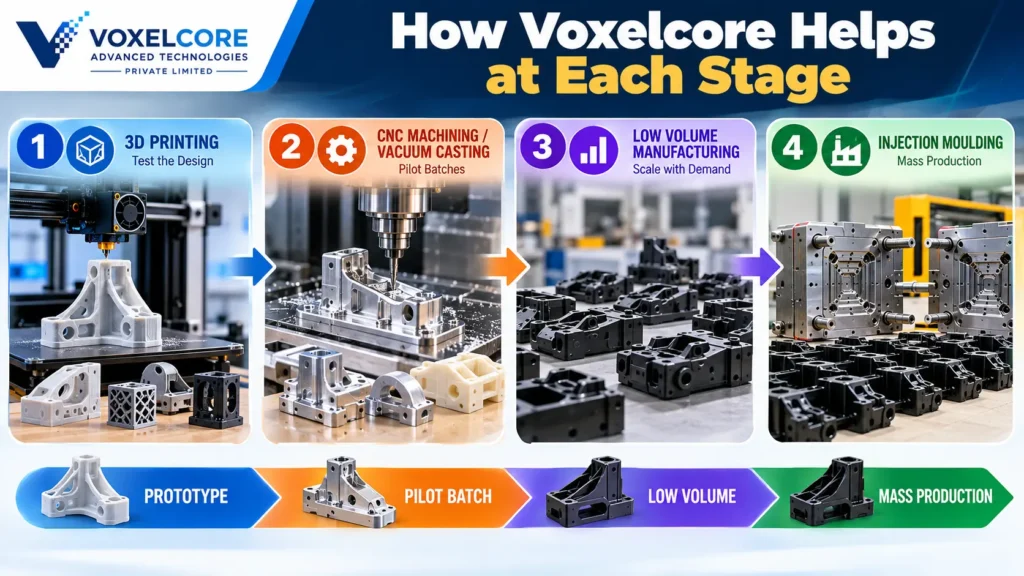
You do not have to pick one process and stay with it. A typical path looks like this:
- Print early versions to test the design.
- Move to CNC machining or vacuum casting for pilot batches.
- Use low volume manufacturing while demand grows.
- Move to moulding once the design is final.
You can see all our services on the 3D printing page, and learn more about Voxelcore India. Ready to compare? Request a quote and tell us your part, material and quantity. We will suggest the process that fits your numbers.
Frequently Asked Questions
Is 3D printing cheaper than injection moulding?
For small runs, yes. Printing has no mould cost. For large runs, moulding wins, because each part costs very little once the mould exists.
How many parts justify an injection mould?
It depends on the mould price and your part. Use the break even formula above. Many sources point to roughly 500 to 1,000 identical parts or more as the zone where moulding starts to make sense.
Is CNC machining better than 3D printing?
It depends on the need. CNC machining gives tighter tolerance and strong, solid parts in metal. 3D printing handles complex shapes and changing designs better.
What is bridge production?
It means making real parts while you wait for production tooling, or while demand is still small. CNC machining, urethane casting and soft tooling are common bridge methods.
Can I start with 3D printing and move to moulding later?
Yes. Many teams do exactly that. Print to test, cast or machine for pilot batches, then mould once the design is final.
Sources
- Hubs: 3D printing vs CNC machining
- Fictiv: bridge production manufacturing
- Wevolver: vacuum casting vs injection moulding
- Zbotic: bulk 3D printing for startups, volume pricing guide India
- IndiaMART: Vanshi Engineering CNC job work
Conclusion
There is no single best process. There is only the best process for the quantity you need now, and the one you will need next.
Here is the whole guide in one minute:
- Print when you need 1 to about 50 parts, or when your design can still change.
- Machine when you need metal, tight tolerance or strong solid parts.
- Cast when you need 10 to 300 plastic parts with a clean, finished look.
- Use soft tooling when you need a few hundred to a thousand parts in real production plastic.
- Mould when you need many hundreds or thousands of identical parts, and the design is final.
Before you spend on a mould, run the break even check. Divide the mould cost by the saving on each part. If your real order falls below that number, keep printing, machining or casting. If it sits well above it, the mould pays for itself.
Most costly mistakes in manufacturing come from moving too early. A mould cut for an unfinished design means paying twice. A printed part used when you needed 3,000 means paying too much on every unit. Match the process to the stage you are in, and move up only when your numbers say so.
Not sure where your part sits? Send us your file, material and quantity. We will tell you which process fits and why, with no pressure to pick ours. Request a quote or talk to the Voxelcore team.