
Table of Contents
Summary
Choosing a 3D printing technology starts with the part, not the machine. Ask what the part must do. FDM suits large, tough, low cost parts where a visible layer pattern does not matter. SLA suits small parts that need fine detail, a smooth surface and tighter accuracy, though many resins are brittle. SLS fuses nylon powder with a laser, so it needs no supports and handles complex shapes, flexing parts and batches. MJF works in a similar way but builds faster, gives even strength in every direction and finer features. Between the two, MJF usually wins on price as quantity grows, while SLS offers a wider choice of materials. In one 2024 comparison, a single part cost less on MJF, ten parts cost almost the same, and one hundred parts cost far less on MJF. Tolerance numbers vary between sources because machine class, part size and material all change the result, so design with room to spare and test small first. Heat matters in India, so tell your printer where the part will live. Always compare quotes with the same material, finish and lead time, and confirm GST with your accountant.
Key takeaways
- Start with what the part must do, then pick the technology.
- Choose FDM for large, tough, low cost parts.
- Choose SLA for fine detail, smooth surfaces and tighter accuracy.
- Choose SLS or MJF for strong nylon parts, complex shapes and batches.
- MJF costs less as quantity grows. SLS offers more material choices.
- Many resins are brittle, so avoid SLA for parts that take impact.
- Tolerances differ between sources, so design with spare room and order a small test print first.
- Heat and sun change what works, so share where the part will be used.
- Compare quotes only when the material, finish and lead time match.
- Most 3D printing services carry 18 percent GST as far as I know, but confirm the service code with your accountant.
The short answer
Pick FDM for large, tough, low cost parts where looks matter less. Pick SLA for small parts that need fine detail and a smooth surface. Pick SLS or MJF for strong nylon parts, complex shapes and batches. Choose MJF over SLS when you need many copies, and SLS over MJF when you need a wider choice of materials.
That is the quick version. Read on to match the technology to your exact part, and to avoid the mistakes that waste money.
Start With the Part, Not the Machine
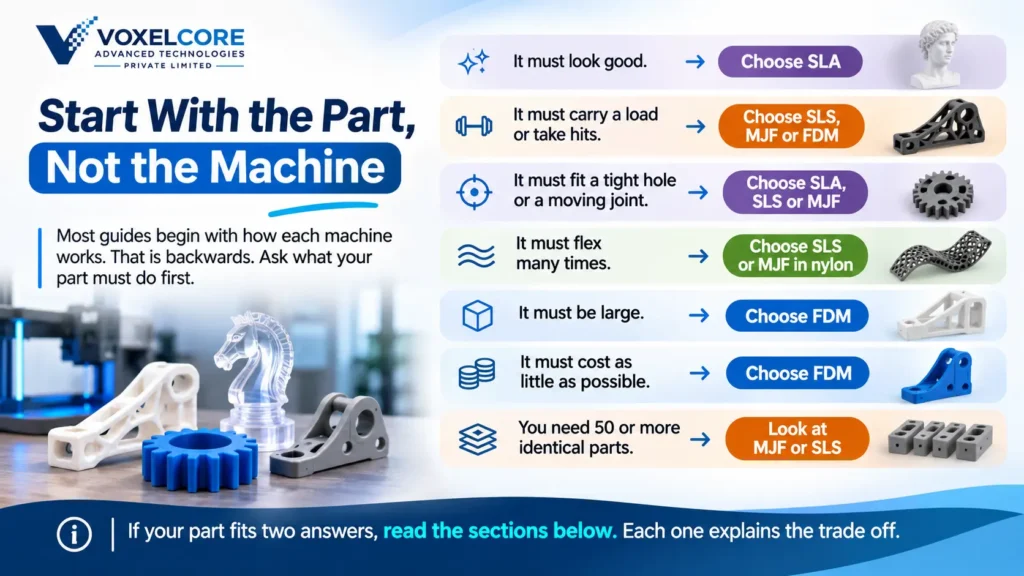
Most guides begin with how each machine works. That is backwards. Ask what your part must do first.
- It must look good: Choose SLA.
- It must carry a load or take hits: Choose SLS, MJF, or FDM in a tough plastic.
- It must fit a tight hole or a moving joint: Choose SLA, SLS or MJF. Check tolerance first.
- It must flex many times: Choose SLS or MJF in nylon.
- It must be large: Choose FDM.
- It must cost as little as possible: Choose FDM.
- You need 50 or more identical parts: Look at MJF or SLS.
If your part fits two answers, read the sections below. Each one explains the trade off.
FDM: The Everyday Workhorse
FDM melts plastic filament and lays it down layer by layer. Think of a hot glue gun guided by a computer.
Choose FDM when:
- You need a quick, low cost model to check shape and size
- The part is big, since FDM handles larger builds
- You want tough plastics such as ABS, PETG or nylon
- A visible layer pattern does not bother you
Skip FDM when:
- You need a smooth surface straight off the printer
- The part has very fine details
- The part will take force across the layers, because FDM parts can split between layers
Layer height usually runs from 0.1 to 0.3 mm. Accuracy depends a lot on the machine. One Indian guide lists ±0.3 to 0.5 mm, while an industrial machine can hold tighter. Always ask the printer for the tolerance on your actual material and size.
SLA: Fine Detail and Smooth Surfaces
SLA uses a light source to harden liquid resin, layer by layer. The result is a smooth, sharp part.
Choose SLA when:
- You need small, detailed parts, such as housings, models and fit checks
- You want a smooth surface that needs little sanding
- Accuracy matters. Zbotic lists about ±0.05 to ±0.15 mm for SLA
- You need special resins, such as clear, flexible or castable types
Skip SLA when:
- The part must be tough. Many standard resins are brittle
- The part will sit in strong sunlight for months
- The part is large, since resin printers have limited build size
Resin parts also need washing and curing after printing. That adds time, which is one reason SLA quotes can look higher than FDM.
SLS: Strong Nylon Parts Without Supports
SLS uses a laser to fuse nylon powder. The loose powder surrounding each part keeps it in place so the machine does not need any support structures. This means that complex shapes, hollow forms and moving parts can be printed cleanly.
Choose SLS when:
- You need strong, functional nylon parts
- Your design has internal channels or tricky shapes
- You want a wide range of materials, such as glass filled and carbon filled nylon
- You are making batches of roughly 10 to 500, a range Zbotic suggests for SLS
Skip SLS when:
- You need a mirror smooth surface, since SLS parts feel slightly grainy
- You need only one cheap part, because FDM usually costs less
MJF: SLS’s Faster Cousin
MJF stands for Multi Jet Fusion. It works on a similar idea to SLS, but it uses heat and a fusing agent instead of a laser. That makes it faster.
Choose MJF when:
- You need many identical nylon parts
- You want strength that stays consistent in every direction
- You want fine features. Protolabs puts MJF feature size near 0.5 mm, against about 0.75 to 1.0 mm for SLS
Skip MJF when:
- You need a very wide material choice, since MJF mostly uses PA11, PA12, glass filled PA12, TPU and PP
- You need a colour other than grey or black without extra finishing
Build size matters too. One Indian service lists a build volume of 350 × 350 × 284 mm for MJF. Check this before you design a big part.
MJF vs SLS: The Choice Most Guides Skip
Both make strong nylon parts. So which one wins?
Wevolver compared them using Xometry data, published in October 2024 with prices from May 2024. These prices are in euros, so treat them as a pattern, not as Indian rates.
- One part: MJF costs less. SLS costs about 20 percent more.
- 10 parts: The two cost almost the same. MJF was about €39.77 each and SLS about €38.96.
- 100 parts: MJF pulls ahead. It was about €21.13 each against €33.01 for SLS.
The reason is speed. MJF builds faster and wastes less powder. About 80 percent of MJF powder can be reused, against 30 to 50 percent for SLS.
In terms of strength, MJF and SLS are similar. For PA12 Wevolver reports 48 MPa for MJF and 50 MPa, for SLS. For glass filled PA12 SLS gives 38 MPa while MJF gives 30 MPa. MJF shows strength in every direction. I find that MJF gives results. SLS strength can change depending on the direction of the load.
The rule of thumb is simple. Use MJF when you want batches and even strength. Use SLS when you need a material that MJF does not provide.
Accuracy: What to Expect and Why Numbers Disagree
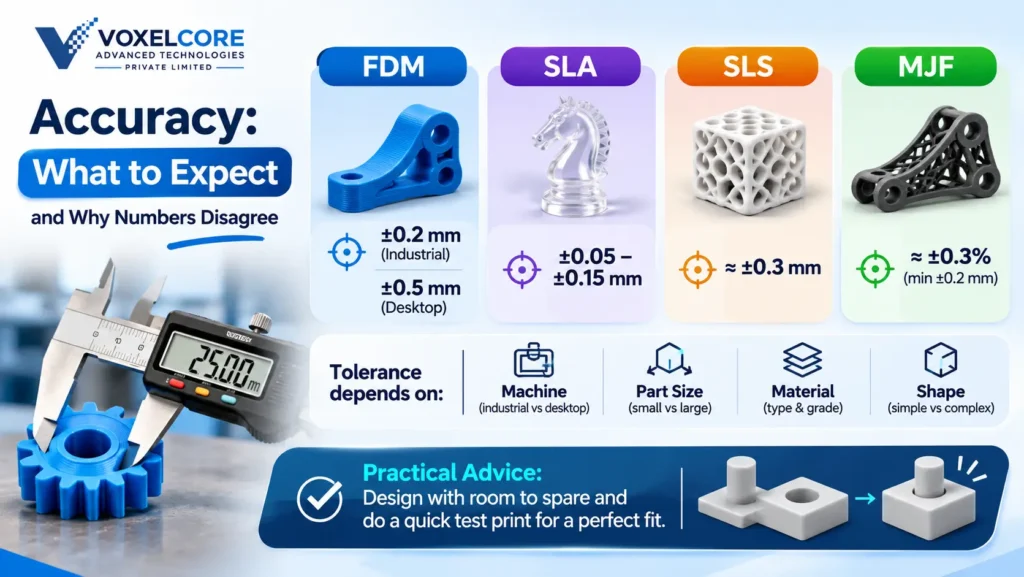
If you read three guides, you will see three different tolerances. That confuses people, so here is why it happens.
Tolerance depends on the machine class, the part size, the material and the shape. A small part holds tighter limits than a large one. An industrial machine holds tighter limits than a desktop one.
Here are the figures from the sources I checked:
- FDM: About ±0.2 mm on industrial machines and ±0.5 mm on desktop ones (Hubs), or ±0.3 to 0.5 mm (Zbotic)
- SLA: About ±0.05 to ±0.15 mm (Zbotic)
- SLS: About ±0.3 mm (Hubs), or about ±0.3 percent with a ±0.3 mm lower limit (Wevolver)
- MJF: About ±0.3 percent with a ±0.2 mm lower limit (Wevolver)
The practical advice: design with room to spare. If a part must fit another part, ask for a small test print first. It costs little and saves a failed batch.
Strength and Finish at a Glance
- FDM: Moderate strength, weaker between layers, visible layer lines
- SLA: Smooth and detailed, but many resins are brittle
- SLS: Strong and flexible, with a slightly grainy surface
- MJF: Strong and even, with a slightly grainy grey surface
Most parts can be improved after printing. Sanding, vapour smoothing, dyeing and painting can all change the look. Formlabs notes that many businesses use two or three technologies together, such as FDM for early checks and SLA or SLS for final parts.
Heat, Sun and Indian Conditions
India is hot, and heat changes what works. Some common plastics soften in a closed car or near a hot machine. If your part will sit outdoors or in a warm place, tell your printer. Materials such as ASA and ABS handle outdoor use better than basic PLA, and nylon holds up well in many functional uses. Ask for a recommendation based on where the part will live, not only how it looks.
Price: Why It Differs, Without a Price Table
Your 3D printing cost guide already explains material, machine time, setup and finishing. This guide keeps to choosing, but one pattern helps here.
In general, FDM costs the least. SLA costs more, because of resin and finishing. SLS and MJF cost more again for a single part, but fall quickly in price when you order many.
As an example, Zbotic lists a 50 g part at about ₹100 to ₹250 in FDM, ₹300 to ₹600 in SLA and ₹500 to ₹900 in SLS. That is one source, not a price list, so treat it as a signal. Always get a written quote.
Lead Times and GST
Lead time depends on the part, the queue and the finishing. Voxelcore’s printing page lists a turnaround of 24 to 72 hours with quotes usually returned within four working hours. SLA and SLS can take longer when finishing is involved so ask for a date in writing.
On tax far as I know, most 3D printing services carry 18 percent GST. The right service code, for a given job can vary. Check with your accountant before you invoice or claim credit.
Common Mistakes to Avoid
- Choosing resin for a part that takes impact. It may crack.
- Choosing FDM for a part with very fine details. The details may blur.
- Ordering SLS for one cheap part. FDM may do the job for less.
- Ignoring minimum wall thickness. One Indian MJF service lists 1.0 mm as the standard minimum and 1.5 mm for tight accuracy or strength.
- Skipping the test print. A small test can catch a fit problem early.
- Comparing quotes without checking material and finish. Two prices only compare when the details match.
A Simple Decision Flow
Answer these in order:
- Is the part bigger than about 300 mm? Choose FDM.
- Does it need a smooth, detailed surface? Choose SLA.
- Does it need strength or flex, or have a complex shape? Choose SLS or MJF.
- Do you need more than about 50 copies? Lean towards MJF.
- Do you need a special material such as carbon filled nylon? Lean towards SLS.
- Is budget your main limit and looks secondary? Choose FDM.
Still stuck? That is normal. Part geometry changes the answer, so the quickest fix is to send us the file.
How Voxelcore Helps You Choose
Voxelcore runs FDM, SLA, SLS and HP MJF under one roof. That means we can recommend the process that fits your part, not the one we happen to own. Learn more on our 3D printing page, or read how to get a 3D printing quote in India to prepare your file.
If you need more than a few parts, our guide to 3D printing vs CNC vs injection moulding shows when to switch process. You can also explore vacuum casting and low volume manufacturing.
Send us your file, your material idea and your quantity. We will tell you which technology fits and why. Request a quote or contact the team.
Frequently Asked Questions
Which 3D printing technology is the strongest?
For plastic parts, SLS and MJF nylon are usually the strongest choice among these four. FDM can be tough in materials like nylon or ABS, but layers can split. SLA resin is often more brittle.
Is MJF better than SLS?
Not always. MJF is faster, builds finer features and costs less for larger batches. SLS offers a wider range of materials. Strength is close.
Is SLA stronger than FDM?
Usually not. SLA gives better detail and finish, but many resins are brittle. FDM in a tough plastic often handles knocks better.
Which 3D printing technology is most accurate?
SLA is generally the most accurate of the four, with about ±0.05 to ±0.15 mm in one Indian guide. SLS and MJF follow. FDM varies most by machine.
Which 3D printing technology is cheapest?
FDM, for a single part. For many identical nylon parts, MJF can become cheaper than SLS.
Can FDM match SLA quality?
Partly. Sanding and finishing can improve FDM, but fine details still favour SLA.
Sources
- Formlabs: FDM vs SLA vs SLS
- Wevolver: MJF vs SLS
- Protolabs: MJF vs SLS
- Zbotic: FDM vs SLA vs SLS with India pricing
- Makenica: MJF 3D printing services
- Hubs: 3D printing vs CNC machining
Conclusion: Match the Technology to the Job
There is no best 3D printing technology. There is only the best one for your part, your quantity and your deadline.
Here is the whole guide in one minute:
- FDM gives you large, tough, low cost parts.
- SLA gives you fine detail, smooth surfaces and tighter accuracy.
- SLS gives you strong nylon parts, complex shapes and a wide material choice.
- MJF gives you strong nylon parts faster, with even strength and lower prices as quantity grows.
Most costly mistakes come from picking by habit. Resin for a part that takes knocks will crack. FDM for a part with tiny details will blur. SLS for one cheap part will cost more than it needs to. A quick check of what the part must do, how many you need and where it will live avoids all three.
Remember two more things. Tolerance numbers differ between sources, so design with room to spare and order a small test print when a fit matters. And compare quotes only when the material, finish and lead time match, or the prices tell you nothing.
Still not sure which one fits? Send us your file, your material idea and your quantity. We run FDM, SLA, SLS and MJF, so we will recommend what suits your part, not what suits our machines. Request a quote or talk to the Voxelcore team.